


You are always disciplined and deeply committed to a sustainable lifestyle. Yet, whenever you go on a vacation - a time when your mind is "unshackled" from work and switches to relaxation mode - the "Zero Waste operating system" you live by suddenly gets powered down.
And you will immediately blame ourselves, chalking it up to a lack of discipline. In reality, the root of the problem lies in a behavioral mechanism that not everyone is aware of.
In behavioral psychology, humans inherently have an unconscious tendency to choose the "path of least effort"٭. Simply put, when faced with two options that satisfy the same need, we naturally lean toward the more convenient, faster, and easier one. This tendency easily makes us susceptible to a "convenience addiction".
Looking at modern society, everything seems designed to fuel this "convenience addiction" with quick, neat, and highly accessible options: a single tap on your screen brings food right to your doorstep, and everywhere you look, products are packaged in single-use plastic. Consequently, maintaining a Zero Waste lifestyle inadvertently demands a significantly higher level of effort:
📌 The effort to actively perceive and filter: Zero Waste practitioners cannot just pick options randomly. They must constantly think and educate themselves to recognize what is a sustainable solution and what is a "convenience trap" harming the environment.
📌 The effort to overcome psychological barriers: You have to defeat your own brain's desire to pick the easiest, most readily available option just to accept carrying a reusable bottle, searching for water refill stations, or washing out reusable containers.
If these actions already consume a fair amount of energy on regular days, the barrier is magnified multiple times during a vacation due to a "reward" and relaxed mindset. The core purpose of traveling is to relieve stress; therefore, our minds naturally prioritize absolute comfort. No one wants to turn their hard-earned vacation into a "to-do list" of chores. When that happens, convenience gains the ultimate upper hand to win the battle.
🤔 Interestingly, you are not alone in this struggle. Even those who have pursued a Zero Waste lifestyle for years frequently "fall off the wagon" when traveling. It is not due to poor discipline, but because the surrounding environment constantly creates conditions that nudge us toward more convenient choices.
🌱 So, how can we maintain a green lifestyle while traveling without putting immense pressure on ourselves?
Perhaps we can start by choosing more suitable destinations.
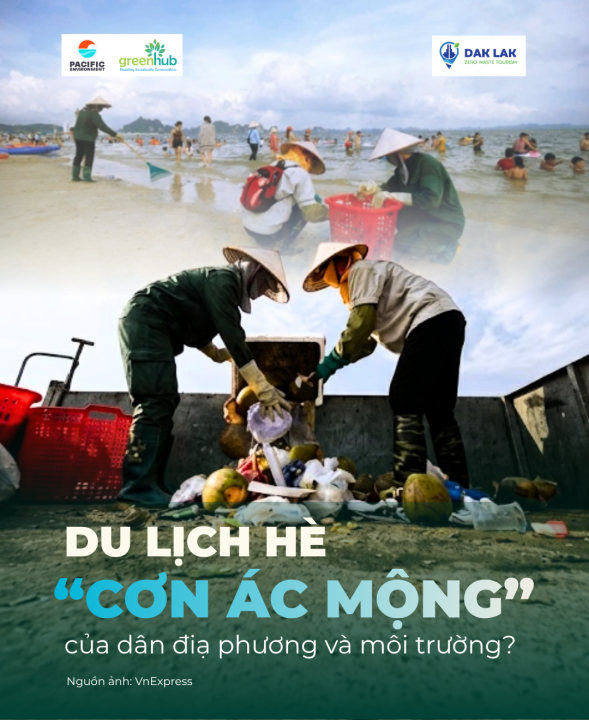
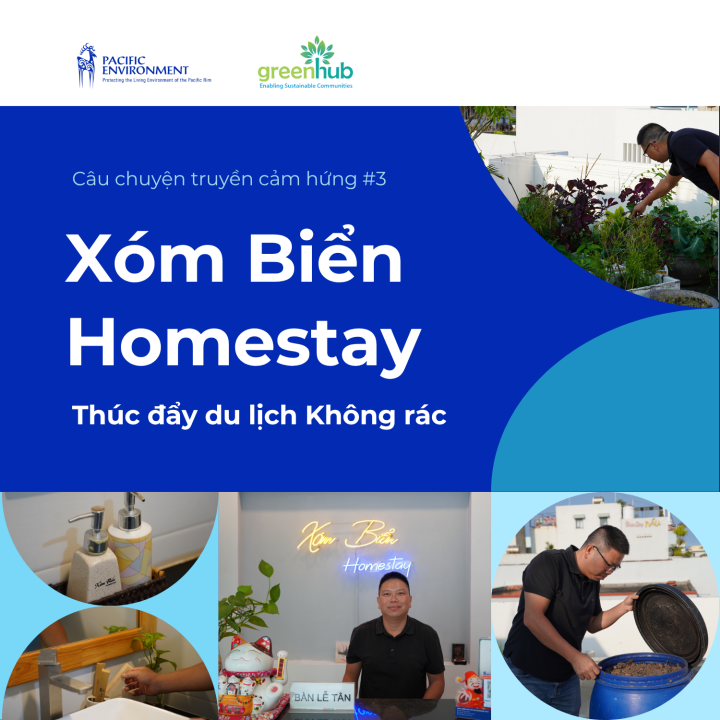
Today, although single-use plastic remains prevalent in the tourism industry, an increasing number of accommodations, coffee shops, restaurants, and tourism businesses are proactively adopting sustainable business models. These are places that limit or replace single-use plastics with sustainable alternatives, provide water refill stations for guests, prioritize eco-friendly products, or simply choose not to serve single-use plastics at all.
When you choose these establishments, living sustainability is no longer a battle between awareness and convenience. Instead, the surrounding environment actively supports you in maintaining eco-friendly habits.
💚 If you occasionally happen to accept a plastic bag or buy a plastic water bottle during a trip, do not rush to think you have failed at your Zero Waste lifestyle. What you lack is not discipline, but rather options that are convenient enough to sustain Zero Waste practices. For green habits to stick long-term, they need to be easy to execute.
To achieve that, this journey requires more than just the continuous struggle of Zero Waste travelers; it calls for the companionship of businesses, destinations, and the entire tourism industry to create more eco-friendly options.
🌱 When sustainable choices become readily accessible, maintaining a Zero Waste lifestyle on every trip will no longer be a challenge, but a natural, seamless part of the journey of exploration.
Source:
٭ Report “Perceptual decisions are biased by the cost to act” (2017): The nervous system continuously calculates the "effort cost" for each action. Even when we believe we are making decisions based on personal preference, the brain covertly biases our choices toward the option that requires the least physical energy, without us even realizing it. https://elifesciences.org/articles/18422
#DakLakZeroWasteTourism
--------------------------------------
Green Development Support Center - GreenHub
🌿 Act together for a green Vietnam
✉️ Mail: info@greenhub.org.vn
🌎 Web: www.greenhub.org.vn



























![[Recap] The event](https://cdn8774.cdn4s10.io.vn/thumbs/upload-files/anh-bai-viet/linh/damen/recap-28-2-25/1_thumb_720.png)




































![[/HēRōS/: ZERO – HEROES OF ZERO] For a Green Ha Long – Mr. Nguyen Duc Hai, Quarter 2, Ha Trung Ward](https://cdn8774.cdn4s10.io.vn/thumbs/article_img_avatar/So-18-01_thumb_720.png)
![[/HēRōS/: ZERO – HEROES OF ZERO] Women’s Union of Quarter 5, Hong Hai Ward](https://cdn8774.cdn4s10.io.vn/thumbs/article_img_avatar/So-16-01_thumb_720.jpg)
![[/HēRōS/: ZERO – HEROES OF ZERO] Women’s Union of Quarter 2A, Cao Thang Ward](https://cdn8774.cdn4s10.io.vn/thumbs/article_img_avatar/So-17-01_thumb_720.png)
![[/HēRōS/: ZERO – HEROES OF ZERO] Meeting the Champions of GreenTalk 2021 – The “Green Quartet” Team](https://cdn8774.cdn4s10.io.vn/thumbs/article_img_avatar/So-11-01_thumb_720.jpg)

![[/HēRōS/: ZERO – HEROES OF ZERO] GreenTalk 2019 Runner-up Nguyễn Thị Hoàng Anh – A Seed That Has Sprouted](https://cdn8774.cdn4s10.io.vn/thumbs/article_img_avatar/So-5-01-min_thumb_720.jpg)